
Best CRM for Real Estate India 2026: How to Choose (Without Wasting ₹2 Lakh)
Discover how to choose the right real estate CRM in India for 2026. Compare top options, avoid costly mistakes, and learn how AI chatbot integration multiplies your CRM's ROI.
Your CRM Is Supposed to Close Deals. Why Is It Just Collecting Dust?
Here's a conversation that happens in every real estate office in India.
The sales head spends ₹1.5 lakh on a CRM subscription. The team gets trained. Everyone logs in for two weeks. Then, slowly, the spreadsheets come back. The CRM becomes a graveyard of half-entered leads and missed follow-ups.
Sound familiar?
The problem isn't the CRM. It's that most real estate teams buy a CRM to solve a data problem — when their actual problem is a speed and qualification problem. A CRM that receives cold, unqualified leads at 6-hour intervals will always underperform. A CRM that receives pre-qualified, context-rich leads in real-time? That's a revenue machine.
Key Takeaways (TL;DR):
- The right real estate CRM in India reduces your cost per qualified lead by 40–60% — but only when paired with an AI chatbot for instant lead capture.
- Most Indian developers fail with CRMs because leads arrive cold, late, and without context — not because the software is bad.
- The best CRM for real estate India in 2026 is the one your sales team will actually use — simple, mobile-first, and pre-integrated with WhatsApp.
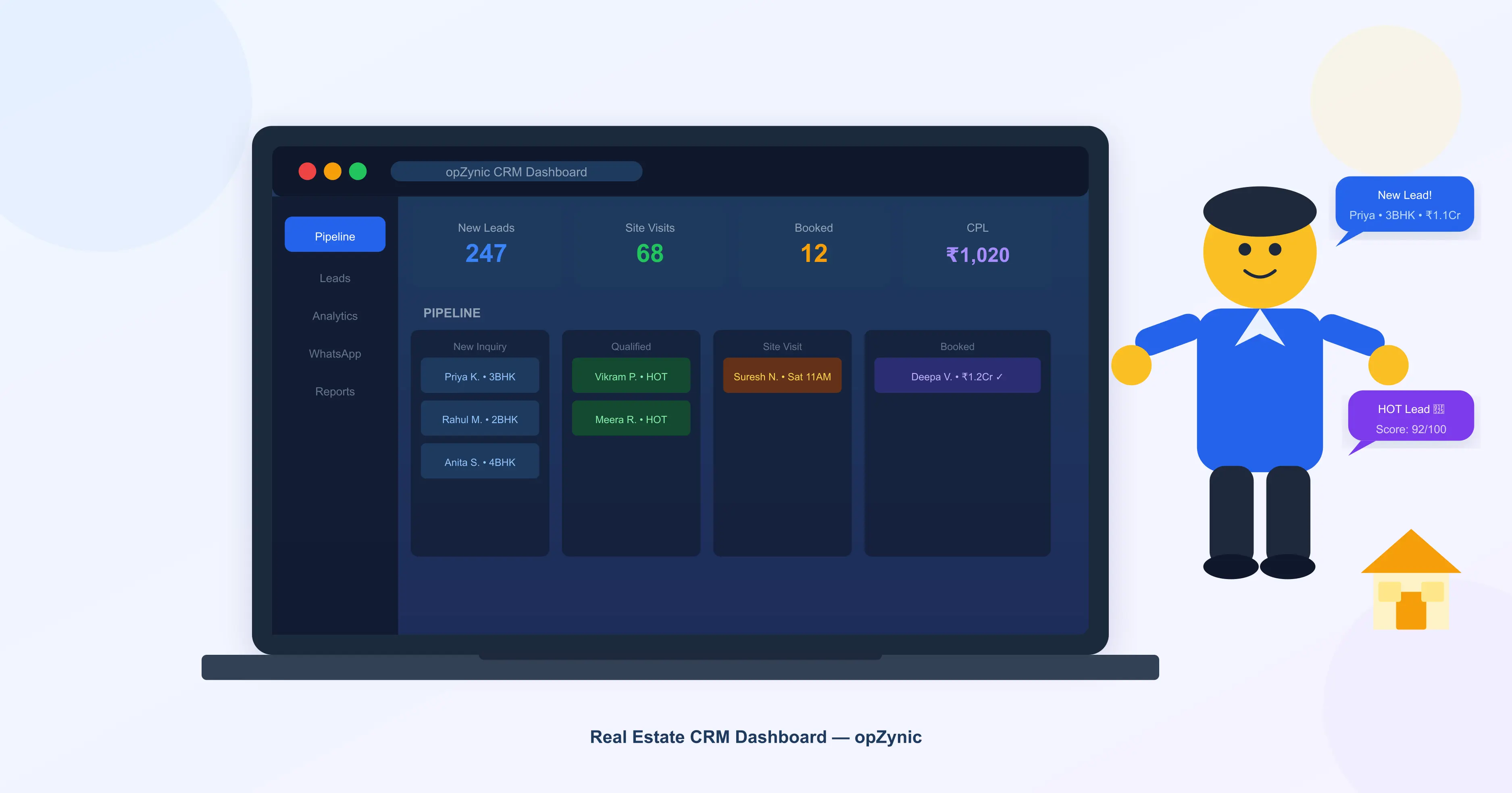
What Is a Real Estate CRM — And Why Do Most Indian Developers Get It Wrong?
A real estate CRM (Customer Relationship Management) is software that centralises all your property leads, tracks every interaction, automates follow-ups, and gives your sales team a single view of every buyer's journey — from first inquiry to booking.
The right CRM answers three questions at a glance:
- Who are my hottest leads right now?
- When did we last contact them, and what did we say?
- What's the next action my team needs to take?
Most Indian developers get it wrong because they treat a CRM as a database — a place to dump leads. The best developers treat it as a command centre — a live system that tells their team exactly who to call, when, and what to say.
The difference between these two approaches is the difference between a ₹2 lakh annual subscription that collects dust and one that generates ₹2 crore in additional revenue.
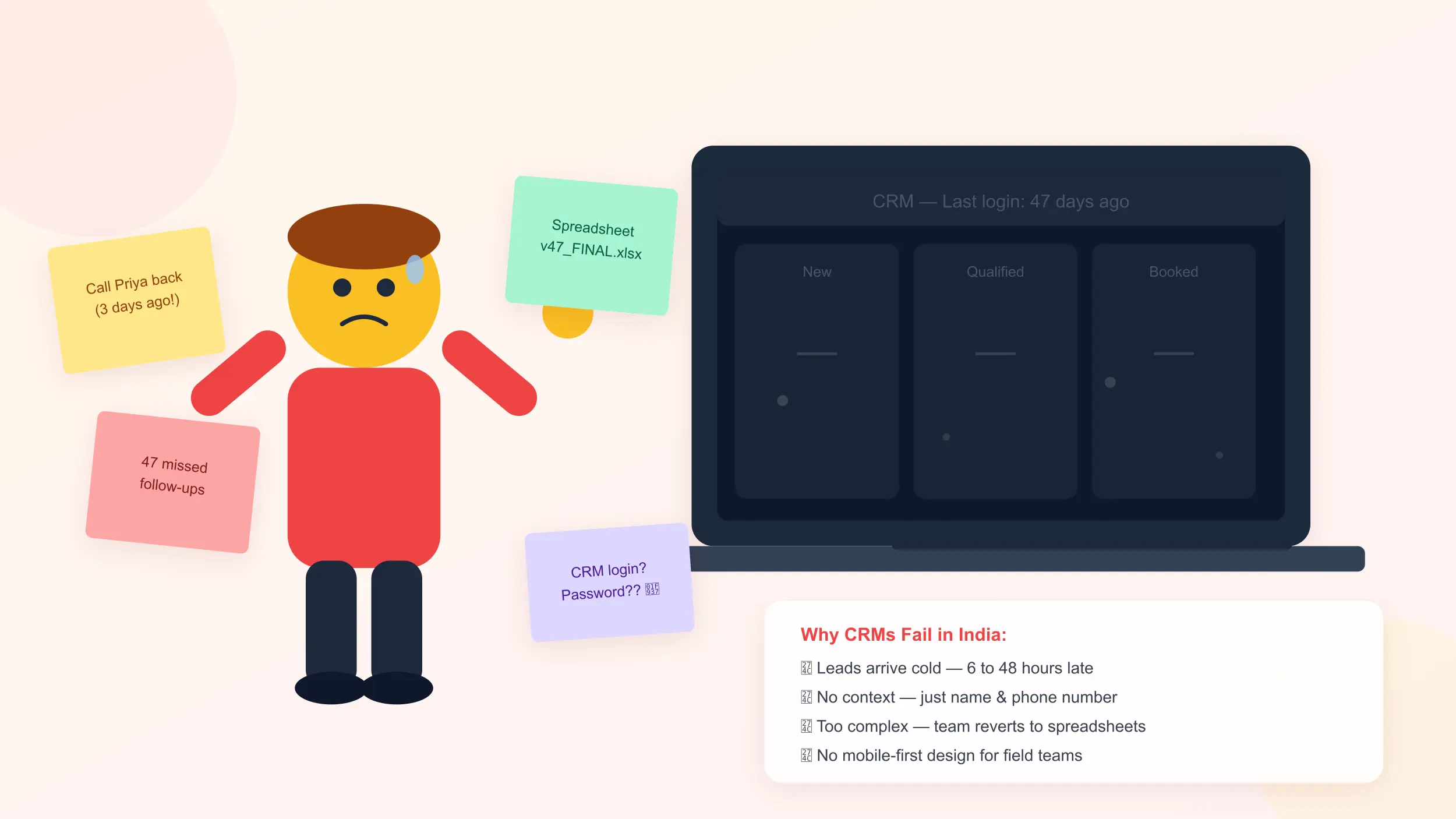
Why Real Estate CRMs Fail in India (The Real Reasons)
Before picking a CRM, understand why they fail. Based on our work with 50+ Indian real estate projects, the failure patterns are consistent:
Reason 1: Leads Arrive Cold and Late
A lead submits an inquiry at 9 PM. The CRM logs it. Your team sees it at 10 AM the next day. By then, the lead has already spoken to two competitors. The CRM didn't fail — your lead capture process did.
This is why 78% of real estate leads go cold before your team even calls. The CRM is only as good as the leads flowing into it.
Reason 2: No Context on the Lead
"Priya Kumar — 9876543210 — Source: Website." That's what most CRM entries look like. Your salesperson calls Priya with zero context. She has to repeat everything she already told the website form. She's annoyed. The call goes nowhere.
Compare that to: "Priya Kumar — interested in 3BHK east-facing Tower B — budget ₹1.1–1.3Cr — timeline 3 months — asked about school proximity — submitted at 10:47 PM." That's a conversation that converts.
Reason 3: Too Complex for Daily Use
Enterprise CRMs built for global sales teams have 47 fields per lead, 12 pipeline stages, and a reporting module that requires a dedicated analyst. Your telecaller in Bengaluru just wants to know who to call next. If the CRM adds friction instead of removing it, the team abandons it.
Reason 4: No Mobile-First Design
85% of Indian real estate sales happen on the move — site visits, client meetings, project walkthroughs. A CRM that only works well on desktop is a CRM your field team will never use.
What to Look for in a Real Estate CRM in India
Not all CRMs are built for Indian real estate. Here's the feature checklist that separates useful from useless:
Must-Have Features
| Feature | Why It Matters |
|---|---|
| WhatsApp Integration | 500M+ Indians use WhatsApp — your CRM must send and log WhatsApp messages natively |
| Mobile App (Android-first) | Field teams need full CRM access on their phones, not a stripped-down mobile view |
| Lead Auto-Assignment | New leads should route to the right executive automatically based on project and budget |
| Pipeline Visualisation | Drag-and-drop Kanban view of every lead's stage — Inquiry → Qualified → Site Visit → Negotiation → Booked |
| Follow-Up Reminders | Automated alerts when a lead hasn't been contacted in X days |
| Source Tracking | Know exactly which ad, portal, or campaign generated each lead |
| AI Chatbot Integration | Pre-qualified leads with full conversation context should flow directly into the CRM |
| RERA-Compliant Reporting | Audit trails and documentation for regulatory compliance |
Nice-to-Have Features
- Email drip sequence automation
- Call recording and logging
- Custom lead scoring rules
- Multi-project management (for developers with 3+ active projects)
- NRI-specific fields (country, time zone, preferred contact window)
Red Flags to Avoid
- Per-user pricing above ₹3,000/month — for a 10-person team, that's ₹3.6 lakh/year before you've closed a single deal
- No Indian payment gateway — if you can't pay in INR via UPI or net banking, support will be a nightmare
- No local support — when your CRM breaks at 6 PM on a Friday before a Saturday launch, you need someone who picks up the phone
The Top CRM Options for Real Estate India in 2026
Here's an honest comparison of the most-used CRMs among Indian real estate developers:
| CRM | Best For | Starting Price | Mobile App | AI Integration | |
|---|---|---|---|---|---|
| LeadSquared | Mid-to-large developers | ₹2,500/user/month | ✅ Native | ✅ Strong | ✅ API available |
| Salesforce | Enterprise developers | ₹5,000+/user/month | ⚠️ Via plugin | ✅ Strong | ✅ Einstein AI |
| Zoho CRM | Small-to-mid developers | ₹800/user/month | ✅ Native | ✅ Good | ✅ Zia AI |
| Kylas | India-first SMBs | ₹1,999/month flat | ✅ Native | ✅ Good | ⚠️ Limited |
| Sell.Do | Real estate specific | ₹2,000/user/month | ✅ Native | ✅ Strong | ⚠️ Limited |
| HubSpot CRM | Digital-first teams | Free (paid from ₹3,500) | ⚠️ Via plugin | ✅ Good | ✅ Strong |
"The best CRM isn't the one with the most features. It's the one your team opens every morning without being told to." — opZynic Research Team
LeadSquared: The Indian Real Estate Standard
LeadSquared dominates the Indian real estate CRM market for good reason. It was built with Indian sales workflows in mind — telecalling queues, field sales tracking, portal integrations (99acres, MagicBricks, Housing.com), and WhatsApp automation are all native.
Where it wins: Lead capture from all sources, telecalling workflow, portal integrations.
Where it struggles: Expensive at scale, complex setup, steep learning curve for smaller teams.
Zoho CRM: The Value Play
For developers with 5–15 person sales teams, Zoho CRM offers the best feature-to-price ratio in India. The mobile app is solid, WhatsApp integration works well, and the AI assistant (Zia) provides basic lead scoring.
Where it wins: Price, flexibility, Indian support team.
Where it struggles: Requires significant customisation to fit real estate workflows out of the box.
Sell.Do: Built for Real Estate
Sell.Do is purpose-built for Indian real estate — it understands project launches, inventory management, and the developer sales cycle natively. If you're running a large project launch with 500+ units, Sell.Do's project-specific features are hard to beat.
Where it wins: Real estate-specific workflows, inventory tracking, launch management.
Where it struggles: Less flexible for non-standard workflows, limited AI capabilities.
The Missing Piece: Why Your CRM Needs an AI Chatbot
Here's the insight most CRM vendors won't tell you.
A CRM manages leads. It doesn't generate them. It doesn't qualify them. It doesn't respond to them at 11 PM when your buyer is browsing after work.
The CRM is the engine. The AI chatbot is the fuel.
When an AI chatbot is integrated with your CRM, here's what changes:
Before AI Chatbot Integration
- Buyer visits website at 10 PM
- Fills a static form (or leaves without filling it)
- Lead enters CRM at 10 PM with: Name, Phone, "Source: Website"
- Sales team sees it at 10 AM next day
- Calls cold lead — buyer has forgotten the project
- Conversion rate: 3–5%
After AI Chatbot Integration
- Buyer visits website at 10 PM
- AI chatbot engages instantly: "Looking for a 3BHK in Whitefield? I can show you available units right now."
- Chatbot qualifies: budget, timeline, preferences, contact details — all captured conversationally
- Lead enters CRM at 10 PM with: Full conversation transcript, budget ₹1.1Cr, timeline 2 months, prefers east-facing, asked about school proximity
- Sales team sees it at 10 AM — calls a warm, pre-qualified lead with full context
- Conversion rate: 15–25%
The same CRM. The same sales team. 5× better conversion. The only difference is what flows into the CRM.
This is why reducing your cost per lead starts with fixing what happens before the lead hits your CRM — not with the CRM itself.
💡 Quick win: Connect your CRM to an AI chatbot and watch your sales team's first-call conversion rate double within 30 days. See how opZynic integrates with your CRM →
How to Set Up Your Real Estate CRM for Maximum ROI
Getting the CRM right is a 5-step process. Most developers skip steps 2 and 3 — which is exactly why their CRM fails.
Step 1: Define Your Pipeline Stages
Don't use the default pipeline. Map it to your actual sales process:
- New Inquiry — Lead just came in, not yet contacted
- Contacted — First call made, conversation logged
- Qualified — Budget, timeline, and preferences confirmed
- Site Visit Scheduled — Appointment booked
- Site Visit Done — Visited, follow-up in progress
- Negotiation — Price/payment plan discussion active
- Booked — Booking amount received
- Lost — Marked with reason (budget mismatch, competitor, not ready)
Step 2: Set Up Lead Auto-Assignment Rules
Every new lead should be automatically assigned to the right executive based on:
- Project — leads for Project A go to Team A
- Budget — leads above ₹2Cr go to senior closers
- Source — NRI leads go to the NRI-specialist executive
- Time — after-hours leads queue for morning assignment with priority flag
Step 3: Configure Follow-Up Automation
Set these automated reminders as a baseline:
- Day 0: Immediate WhatsApp message with project brochure (triggered by AI chatbot or form fill)
- Day 1: Reminder to call if no contact logged
- Day 3: Follow-up WhatsApp if no site visit booked
- Day 7: Alert if lead has been in "Contacted" stage for 7 days without moving
- Day 14: Escalation alert to sales manager
Step 4: Integrate Your Lead Sources
Connect every lead source to your CRM so nothing falls through the cracks:
- Website AI chatbot (primary — highest intent)
- 99acres, MagicBricks, Housing.com (portal leads)
- Facebook Lead Ads (social leads)
- Google Ads (search leads)
- WhatsApp Business (direct inquiries)
- Walk-in registration (offline leads)
Step 5: Train Your Team on the One Rule
The only CRM rule that matters: if it's not in the CRM, it didn't happen.
Every call, every WhatsApp, every site visit — logged. This isn't bureaucracy. It's the data that tells you which lead sources convert, which sales executives close, and which pipeline stages are leaking. Without it, you're flying blind.
Real Estate CRM ROI: What the Numbers Look Like
Here's what a properly configured CRM + AI chatbot stack delivers, based on our deployments across Bengaluru, Hyderabad, and Pune:
| Metric | Without CRM + AI | With CRM + AI Chatbot | Improvement |
|---|---|---|---|
| Lead response time | 6–48 hours | Under 2 seconds | 99% faster |
| Lead context at first call | Name + phone only | Full conversation + preferences | Qualitative |
| Follow-up compliance | 40–60% of leads followed up | 95%+ (automated reminders) | +55% |
| Lead-to-site-visit rate | 4–8% | 18–28% | 3–4× |
| Sales team productivity | 30–40 calls/day | 50–70 meaningful conversations/day | +60% |
| Cost per booked unit | ₹80,000–1,20,000 | ₹25,000–45,000 | -60% |
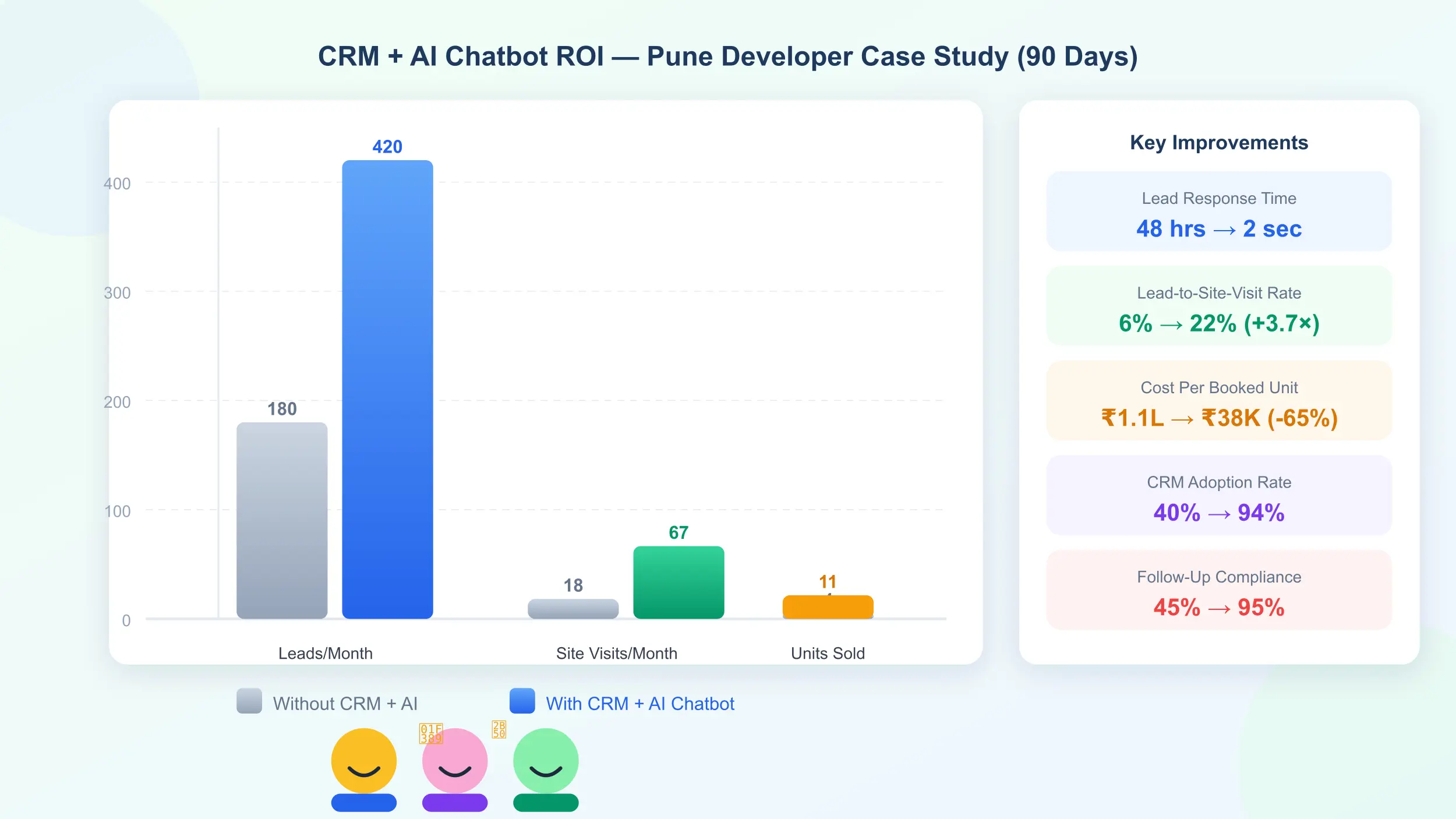
A developer in Pune running 2 active projects implemented this stack in Q4 2025. Within 90 days:
- Leads captured: Up from 180/month to 420/month (same ad spend)
- Site visits: Up from 18/month to 67/month
- Units sold in Month 3: 11 vs 4 in the same month the previous year
- CRM adoption rate: 94% (vs 40% with their previous CRM)
The adoption rate jump came from one change: leads arrived pre-qualified with full context. When your CRM makes your team's job easier instead of harder, they use it.
How to Choose: The 3-Question Framework
If you're still unsure which CRM to pick, answer these three questions:
Question 1: How big is your sales team?
- 1–5 people → Zoho CRM (free tier or ₹800/user/month)
- 6–20 people → Kylas or Sell.Do (flat pricing, real estate-specific)
- 20+ people → LeadSquared or Salesforce (enterprise features justify the cost)
Question 2: How many leads do you generate per month?
- Under 200 leads/month → Any CRM works; focus on AI chatbot integration first
- 200–1,000 leads/month → You need auto-assignment and telecalling workflows (LeadSquared, Sell.Do)
- 1,000+ leads/month → Enterprise CRM with AI scoring is non-negotiable
Question 3: Do you have NRI buyers?
- Yes → Ensure the CRM supports time-zone fields, international phone formats, and WhatsApp (NRIs use WhatsApp internationally). Pair with a multilingual AI chatbot for 24/7 NRI engagement.
- No → Standard Indian CRM options work fine
FAQ: Real Estate CRM India
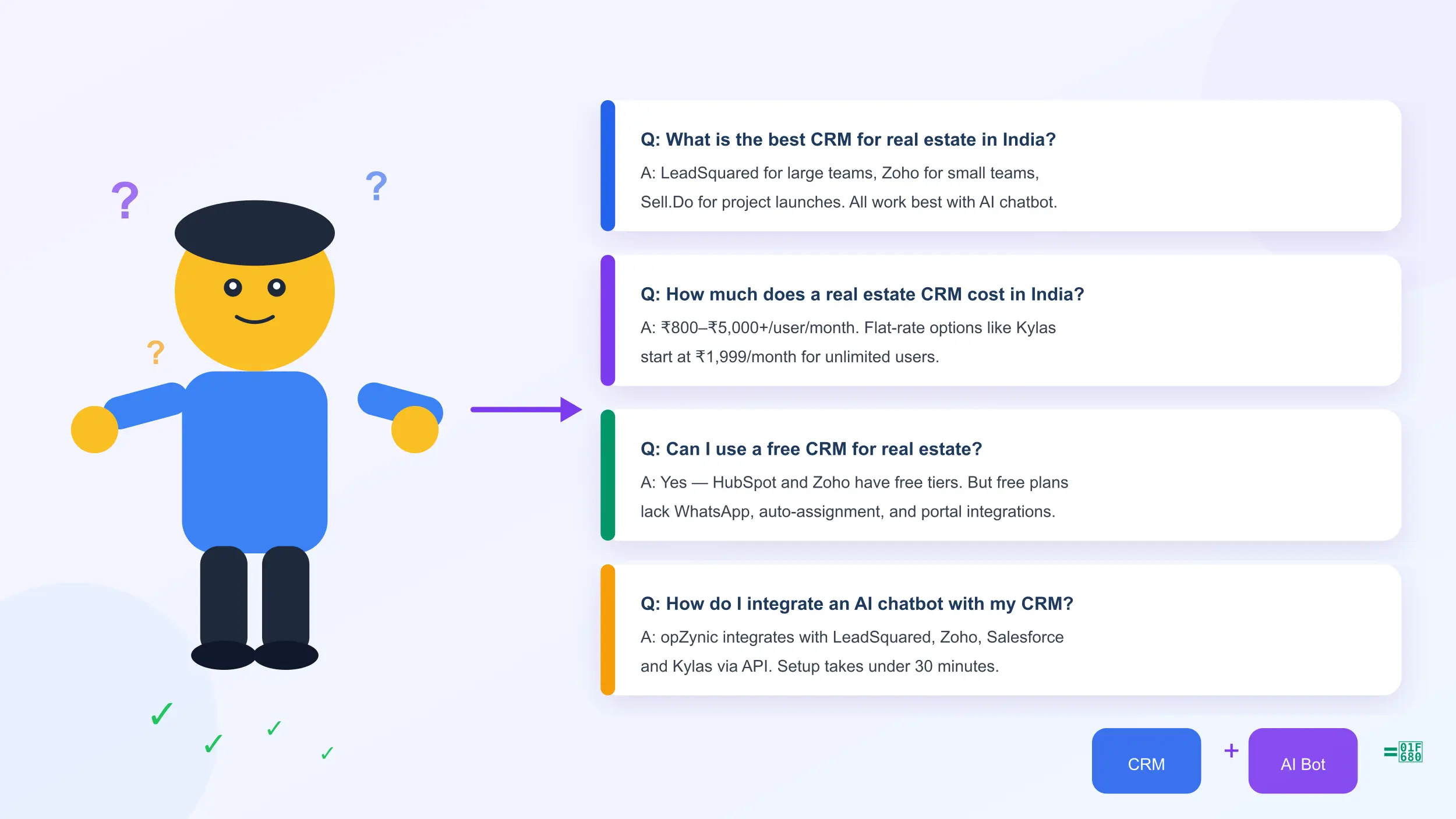
What is the best CRM for real estate developers in India?
The best CRM for real estate developers in India depends on team size and budget. LeadSquared is the most widely used for mid-to-large developers due to its native portal integrations and telecalling workflows. Zoho CRM offers the best value for smaller teams. Sell.Do is purpose-built for real estate project launches. All three work best when integrated with an AI chatbot for pre-qualified lead delivery.
How much does a real estate CRM cost in India?
Real estate CRM costs in India range from ₹800 to ₹5,000+ per user per month. Flat-rate options like Kylas start at ₹1,999/month for unlimited users. Enterprise options like Salesforce can exceed ₹10,000/user/month. The total cost of ownership includes setup, training, and integration — budget ₹50,000–2,00,000 for a proper implementation.
Can I use a free CRM for real estate in India?
Yes — HubSpot CRM offers a genuinely useful free tier that works for small real estate teams. Zoho CRM also has a free plan for up to 3 users. However, free plans typically lack WhatsApp integration, auto-assignment, and portal lead capture — features that are essential for Indian real estate workflows. Most teams outgrow free CRMs within 6 months.
How do I integrate an AI chatbot with my real estate CRM?
Most modern AI chatbots integrate with CRMs via API or native connectors. opZynic integrates directly with LeadSquared, Zoho CRM, Salesforce, and Kylas — pushing qualified leads with full conversation context into your CRM in real-time. Setup takes under 30 minutes. The result: every chatbot conversation becomes a CRM entry with budget, timeline, preferences, and contact details pre-filled.
What data should a real estate CRM capture for each lead?
A real estate CRM should capture: full name, phone number, email, lead source, project of interest, budget range, purchase timeline, unit type preference (2BHK/3BHK), location preference, last contact date, conversation history, lead score, assigned executive, and pipeline stage. When an AI chatbot feeds the CRM, most of these fields are populated automatically before your team makes the first call. According to JLL India's 2025 residential market report, developers who adopt integrated digital sales tools see 2–3× faster inventory absorption compared to those relying on manual processes.
The Bottom Line: CRM + AI Chatbot = Your Unfair Advantage
A CRM alone won't fix your lead conversion problem. Neither will an AI chatbot alone.
Together, they create a system where:
- Every lead is captured — 24/7, including after hours and weekends
- Every lead arrives with context — budget, timeline, preferences, conversation history
- Every lead is followed up — automated reminders ensure nothing falls through the cracks
- Your team focuses on closing — not data entry, not cold calling, not chasing unqualified inquiries
The developers winning in Bengaluru, Hyderabad, and Pune in 2026 aren't the ones with the biggest ad budgets. They're the ones with the tightest systems. A well-configured CRM connected to an AI chatbot is that system.
It's also the foundation of a high-performing real estate sales team — one where your best closers spend their time closing, not qualifying.
Ready to connect your CRM to an AI chatbot that pre-qualifies every lead before your team picks up the phone? Book a free opZynic demo and see the integration live.
Related Articles
Ready to Convert More Leads?
See how opZynic can transform your real estate website into a 24/7 sales machine.
Start Free Trial